Moving Beyond “Technology-Push”
Conventional knowledge valorisation usually follows a linear path: researchers develop a technology first and then look for companies that might want to buy or license it, typically within established sectoral or regional networks.
During the roundtable, the BEAGLE team showcased how we flip this model on its head through a demand-led, co-creative pathway:
Phase I (Industry Demand): Through an open call, we engaged more than 120 CEOs, CTOs, and project managers to identify challenges, unmet needs, and emerging market opportunities—resulting in 60 selected video factsheets published on the open and neutral BEAGLE Marketplace.
Phase II (Research Offer): A second open call engaged more than 120 researchers across our consortium to match those industry demands with university and research centre capabilities, producing 60 innovation-offer video factsheets.
Phase III (Actionable Partnerships): These academia–industry connections are formalized as 20 action plans for implementation and partnership, spanning sectors and regions such as renewable energy with AI, personalized health, and IoT for smart cities.
5 Policy Recommendations for the Future of European Innovation
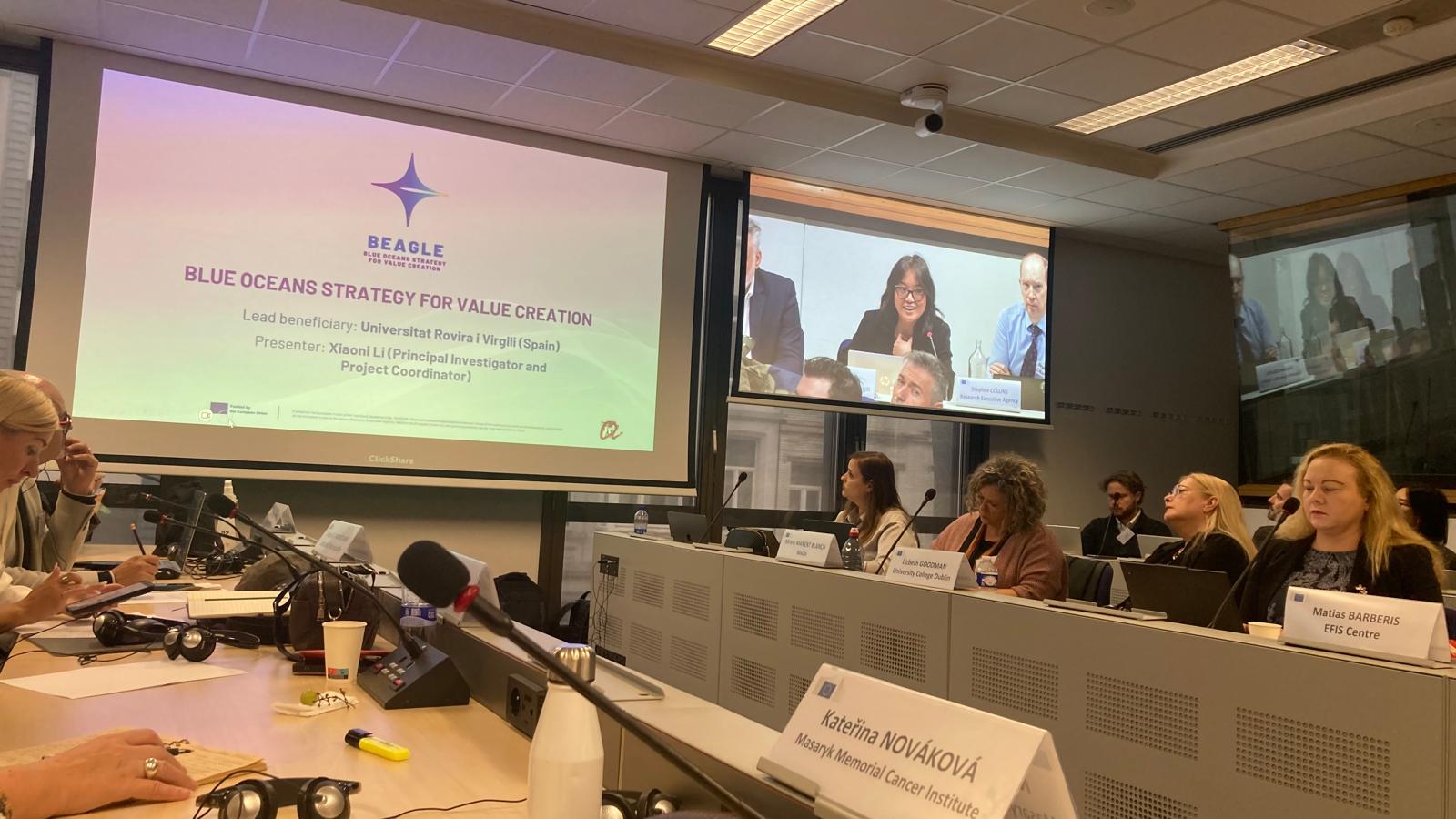
Drawing directly from our hands-on experience building these bridges, Xiaoni and the URV team presented five actionable recommendations during the discussion to help shape future European Research & Innovation (R&I) policies:
Build a European framework for cross-border, cross-sectoral knowledge valorisation: “Blue Ocean” opportunities do not appear within a single region or sector—they emerge when industry demand and university research offers connect beyond regional and sectoral boundaries. Bringing together a Czech biobank and a Spanish spin-off created value that neither side could have generated alone.
Empower knowledge-transfer professionals: Intermediaries shouldn’t be treated merely as administrative roles managing agreements. With the right training, methodologies, and tools, they can identify industry needs, match research capabilities, and bridge the language gap between academia and business as strategic innovation facilitators.
Make knowledge valorisation market-driven: Research too often moves from the laboratory outwards. BEAGLE worked the other way around: unmet market and societal needs—the unexplored blue oceans—were identified first, and research-based solutions were co-created to address them. Policy should reflect this market-driven logic through institutional incentives that focus on the need rather than the technology.
Turn matchmaking into implemented collaboration: Matching partners is the beginning, not the end. BEAGLE’s structured toolkit—comprising Mixed Teams, video factsheets, the BEAGLE Marketplace, and facilitated co-creation—helped surface partner needs and capabilities and guide initial matches toward concrete joint projects. National and regional R&I programmes should embed this structured support alongside dedicated follow-on funding.
Measure value beyond traditional indicators: Patents, licences, and spin-offs matter, but they take time and capture only part of the value created. Policy should also recognize pathway indicators: cross-sector connections, value-chain opportunities, engagement quality, and action plans.
A Shared European Effort
Events like the KALEIDOS Final Conference highlight how valuable cross-project dialogue is in practice. Thank you to our sister project KALEIDOS, as well as CEETNOVA and ERIS, for an inspiring exchange on turning European knowledge into lasting market and societal value.